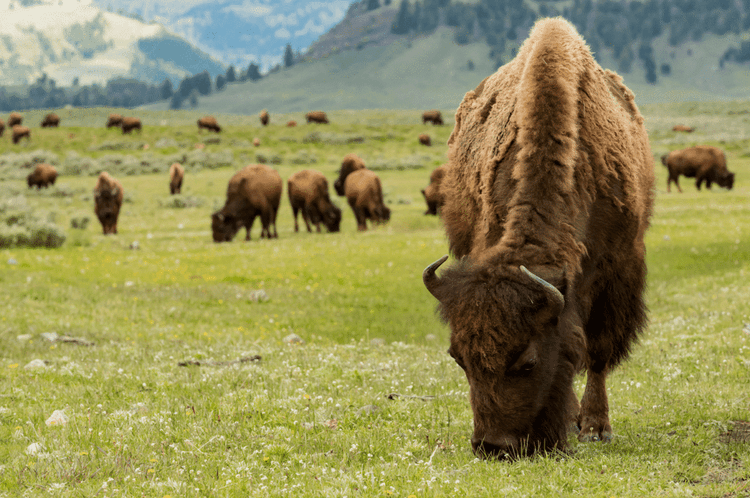
Yellowstone National Park is witnessing a striking ecological recovery driven by the return of roughly 5,000 bison whose migration across the park’s grasslands is restoring ancient patterns and reshaping the landscape from the ground up according to a groundbreaking study published in Science. These bison, descendants from the last surviving wild herd, now roam across nearly 1,000 miles each year along a 50 mile corridor, and by grazing, trampling, and fertilizing the land they create a mosaic of habitats that supports a wider variety of plants and animals from insects to predators. Research led by ecologist Bill Hamilton at Washington and Lee University compared vegetation and soil chemistry on grazed and fenced plots, discovering that despite heavy grazing, plants grew as robustly as in undisturbed areas and were an astonishing 150 percent richer in protein.
Hamilton describes the transformation as a true reawakening of what had been there in the past, urging people to consider how far landscapes had shifted from their original state since bison were nearly wiped out in the 19th century. Yellowstone grasslands are now functioning better than in the bison’s absence, offering a glimpse of what was lost and providing scientists with rare insights into how large herbivores influence entire ecosystems. While the park’s bison population fluctuates between 2,400 and 5,500, policymakers are considering expanding their range with tribal trust support to strengthen genetic resilience by allowing herds from different areas to mix freely. The revival follows decades of conservation, habitat protection, and multi agency management designed to balance ecological restoration with disease control and agricultural concerns, though challenges remain with herd mobility constrained by borders and human wildlife conflict. The success at Yellowstone proves that when given space to roam, bison can reconnect fragmented habitats and ensure populations remain healthy and adaptable while restoring landscapes to their natural functioning state.