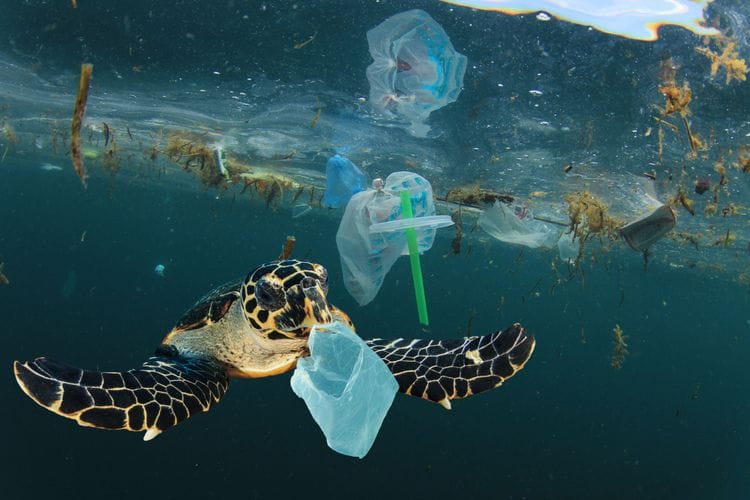
MIT senior Jacqueline Prawira was watching butchers discard fish scales at her family’s Asian market when she noticed something remarkable: the scales were strong, thin, flexible, and lightweight, possessing the exact properties that make plastic so useful. That observation led her to develop biodegradable plastic like materials from fish offal that can be used for disposable products like grocery bags, packaging, and utensils, addressing one of the world’s most pressing environmental challenges as plastics are expected to outweigh fish in the ocean by 2050. Unlike traditional plastics that last forever because “we basically made plastics to be too good at their job,” Prawira’s fish scale material and composite will degrade naturally in composting environments without needing much, if any, external help.
This isn’t Prawira’s first environmental breakthrough, as she previously worked in Professor Yet Ming Chiang’s lab to develop a low carbon process for making cement called silicate subtraction that enables compounds to form at lower temperatures, cutting fossil fuel use significantly. The same method is now being used to extract valuable lithium with zero waste through a patented process being commercialized by startup Rock Zero. For her achievements, Prawira recently received the prestigious Barry Goldwater Scholarship awarded to undergraduates pursuing careers in science, mathematics, or engineering. Featured on CBS’s “The Visioneers with Zay Harding” during Climate Week NYC, she shared her hope that daily life can become more in sync with the environment, so people don’t always have to choose between convenience and protecting the planet, proving that sometimes the answers to seemingly impossible problems are hiding in the waste we throw away every single day.