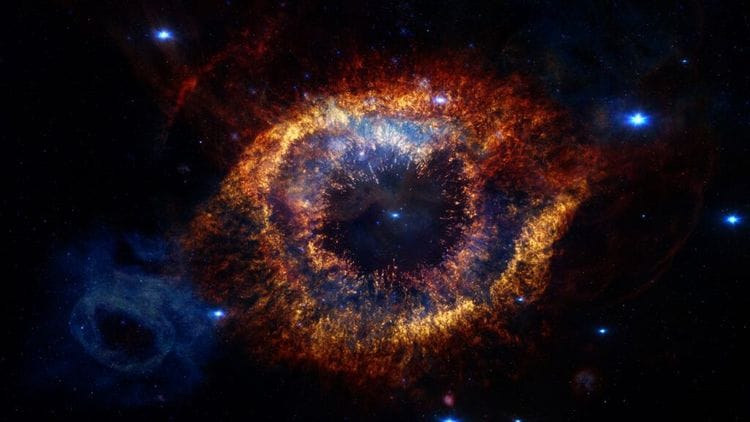
The James Webb Space Telescope has captured the most spectacular infrared image ever taken of the Helix Nebula, one of the closest planetary nebulae to Earth located approximately 655 light years from our Solar System and nicknamed the Eye of God or Eye of Sauron for its striking ring like shape. First spotted in the early 1800s, this iconic nebula has been photographed by countless ground and space based observatories over nearly two centuries, but Webb’s near infrared view brings detail that astronomers say reveals the possible eventual fate of our own Sun and planetary system about 5 billion years from now. In the high resolution image from Webb’s NIRCam camera, thousands of orange and gold comet like pillars stream outward showing the structure of gas being shed off by a dying star as blistering winds of fast moving hot gas crash into slower moving colder shells of dust and gas that were shed earlier in its life.
The extraordinary infrared view reveals temperature and chemistry within the nebula with remarkable clarity, showing blue hues marking the hottest gas being blasted by the central white dwarf’s radiation, yellow regions where gas has cooled further from the white dwarf, and red hued coolest material at the edge of the expanding shell. Scientists explain that this image is more than just visually striking because it demonstrates how stars recycle their material back into the cosmos by seeding future generations of stars and planets with the ingredients from which new celestial objects can eventually form. Webb’s increased resolution brings these comet shaped knots to the forefront compared to the ethereal image previously captured by the Hubble Space Telescope and sharpens focus beyond what NASA’s retired Spitzer Space Telescope achieved. The new near infrared look shows the stark transition between the hottest gas to the coolest gas as the shell expands outward from the central white dwarf, revealing pockets where complex molecules are beginning to form within clouds of cosmic dust that prove the cosmos excels at recycling old material into new objects.