Wildlife Surveyors Found 7 Mummified Cheetahs In Saudi Caves And Their DNA Rewrote History
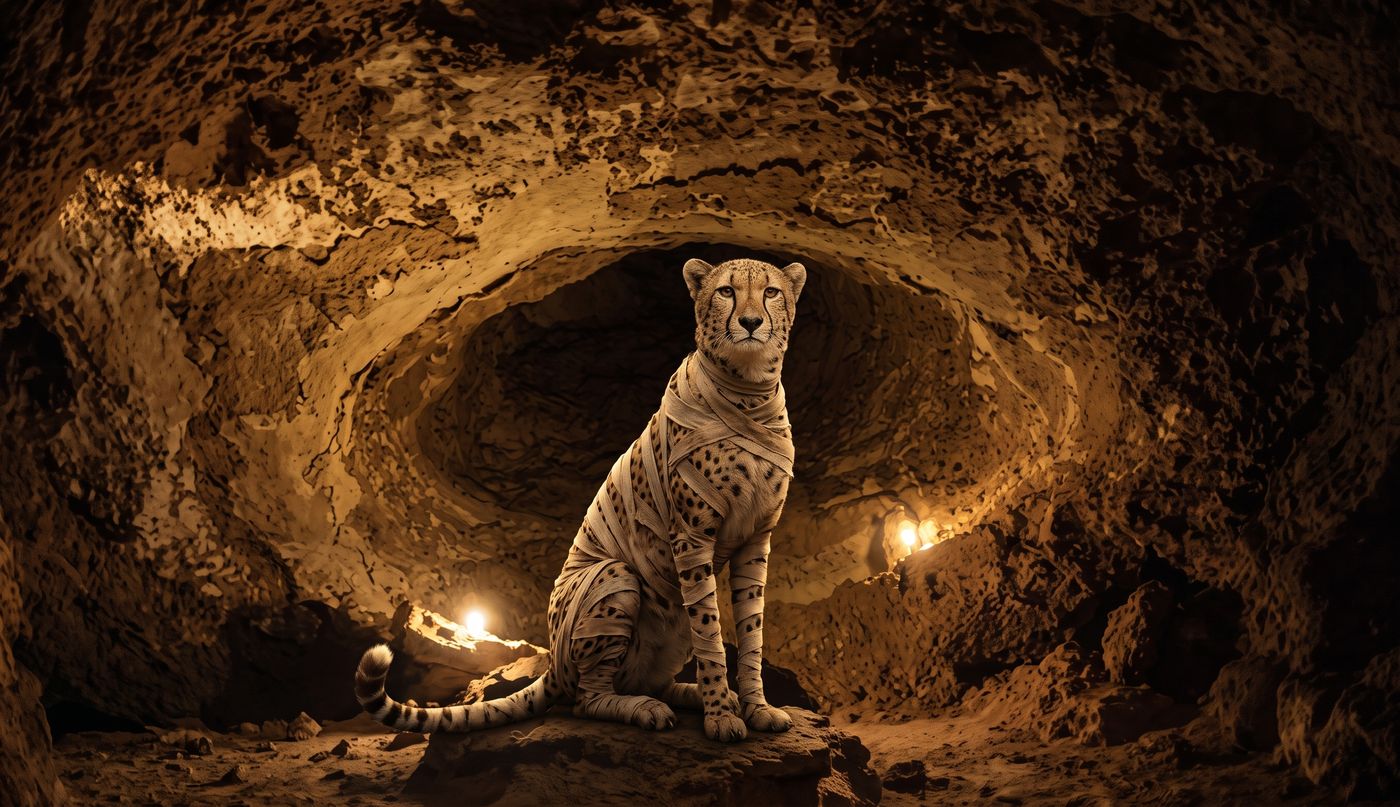
Scientists with the National Center for Wildlife in Saudi Arabia were conducting cave surveys near the northern city of Arar when they found something that nobody expected: seven naturally mummified cheetahs spread across five separate caves, their soft tissue and skeletons largely intact, preserved by the hyper-arid conditions of the cave environment over an extended period. Alongside the seven mummies, the survey team also found skeletal remains of 54 additional cats within the same caves. Cheetahs entering caves is itself described as extremely atypical behavior, making both the discovery and its context surprising before any analysis had even begun. When researchers extracted complete genome sequences from three of the seven mummies, the findings rewrote the accepted history of which cheetah subspecies had ever lived in the Arabian Peninsula. It had previously been believed that only the Asiatic cheetah, known as Acinonyx jubatus venaticus and now critically endangered with a small remaining wild population in Iran, had ever been present in Saudi Arabia. Two of the oldest mummies turned out to be genetically closer to a different subspecies entirely: Acinonyx jubatus hecki, the Northwest African cheetah, making this the easternmost recorded evidence of an African cheetah subspecies and proving that at least two distinct cheetah lineages once coexisted in the region across different time periods.
The findings, published in the journal Communications Earth and Environment, mark the first time DNA has ever been extracted from naturally mummified cheetahs or any naturally mummified large feline, making the methodological achievement as significant as the genetic result itself. Lead author Ahmed Al Boug, an ecologist and deputy CEO of the National Center for Wildlife in Saudi Arabia, described the discovery as highly surprising and said it represents the first documented case of natural mummification in cheetahs as well as the first physical evidence that multiple cheetah subspecies historically occupied the Arabian Peninsula. The practical implications extend beyond paleontology. Cheetahs were declared locally extinct in Saudi Arabia in the 1970s, and the Saudi government has active plans to reintroduce wildlife to restore the ecosystems that once existed across the desert. Knowing which subspecies historically occupied which regions is essential information for making reintroduction decisions that are genetically and ecologically appropriate, and the genome data from the mummies now provides a baseline that was not available before. Natalia Borrego, a researcher involved in the analysis, noted that cheetahs play a critical role as apex predators supporting broader biodiversity, and that their return to the Arabian Peninsula would be an important addition to the rewilding effort already underway across the region.
Source:https://www.yahoo.com/news/articles/scientists-extracted-dna-mummified-cheetah-150204075.html