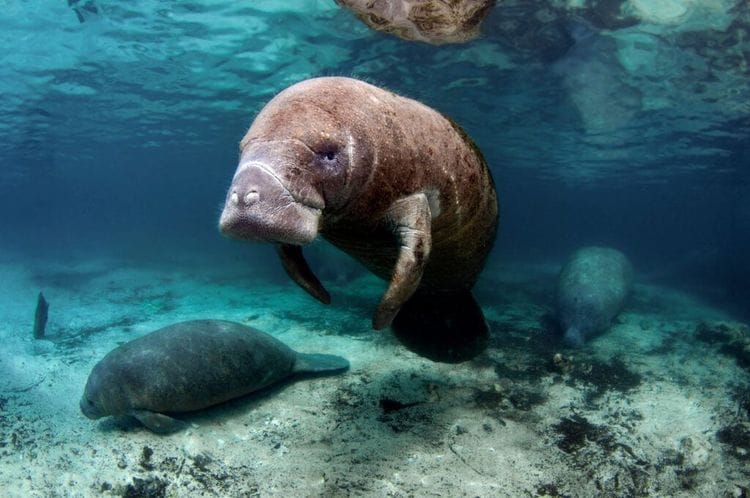
Nicholas Pyenson, curator of fossil marine mammals at the National Museum of Natural History, co-authored groundbreaking research that reveals a treasure trove of fossils uncovered in southwestern Qatar, proving that anateesm have been protecting ocean ecosystems for tens of millions of years. The team discovered a distant relative of modern dugongs in rocks less than 10 miles from a bay with thriving seagrass meadows that still serve as prime habitat today, demonstrating that this region has been ideal sea cow territory for 21 million years with different species occupying the same ecological role across the millennia. Manatees and dugongs, affectionately nicknamed sea cows for their peaceful grazing habits in seagrass meadows, are more closely related to elephants, aardvarks, and rodent-like hyraxes than to other marine animals, sharing downturned snouts, sensitive bristles, and large torpedo-shaped bodies. These gentle giants maintain ocean health by consuming roughly 10 percent of their body weight in seagrass daily, which helps preserve seagrass bed ecosystems that capture carbon and provide crucial habitat for vulnerable marine life.
The environmental benefits extend beyond their grazing, as manatees and dugongs act as natural fertilizers by pooping in underwater habitats and recycling vital nutrients back into the ocean in a process that supports entire ecosystems. Ferhan Sakal explained that locals once called the fossil-rich area a dugong cemetery but had no idea just how vast and rich the bonebed actually was until archaeological teams began systematic excavation. Pyenson emphasized that while scientists know modern marine mammals can have disproportionate impacts on ocean ecosystems, this research marks one of the first times experts can definitively point to evidence and confirm these ecological relationships have existed for tens of millions of years. By studying past climate records preserved in the region’s rocks, Sakal notes that researchers can better understand how seagrass communities survived major climate stresses including sea level changes and salinity shifts, knowledge that helps set achievable conservation goals for protecting the vulnerable dugong and manatee populations that continue playing these critical roles in oceans today.